
Farming With Data: Transforming Ghana's Agriculture Sector


Ghana produces several staple foods locally, yet the country still relies heavily on imports for key food products. For example, reports from institutions such as the African Development Bank Group indicate that over 50% of rice consumed in Ghana is imported. This highlights both a food security challenge and a significant opportunity for local job creation, income generation, and industry growth.
Transforming Ghana’s agricultural sector will require coordinated action across multiple areas, including financing, infrastructure, logistics, research, and farmer education. While each of these areas is important, one opportunity is the use of data to support agricultural decision-making.
In this article, I explore how data can play a role in improving Ghana’s farming sector by enabling farmers and agribusiness owners to:
identify the most productive crops
optimize pest control strategies
Identifying the most productive crops
Agribusiness owners and farmers often choose which crops to plant based on familiarity, tradition, or observation - perhaps because it is what others in the area are planting, or what previous generations have cultivated for years. Data can however help farmers move beyond intuition and make more informed decisions about which crops are likely to be the most productive and profitable.
To do this, some key data points that could be tracked include:
crop type and seed variety
planting date, harvesting date, and growth duration
yield per acre
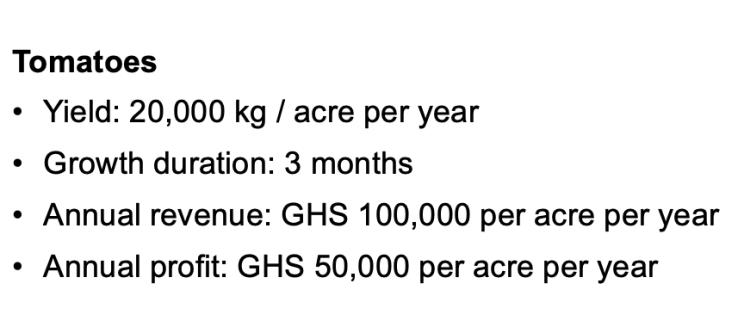
The data may, for example, reveal the following:

Note: These insights are hypothetical and intended to illustrate the potential value of data. They may not reflect actual market conditions.
On average, tomatoes take about 3 months to reach maturity. This results in an estimated yield of about 20,000 kg per acre per year and a corresponding annual profit of around GHS 50,000.
Cassava, on the other hand, takes approximately 9 months to mature. This results in an estimated yield of about 8,000 kg per acre per year and a corresponding annual profit of around GHS 7,000.
All other things equal, agribusiness owners may prioritise tomatoes since they generate significantly higher revenue and profit per acre within a shorter production cycle.
Optimising pest control strategies
Pest infestations are a major cause of crop loss for farmers. The International Institute of Tropical Agriculture estimates that pests and diseases cost Ghana’s agricultural sector about USD 1 billion annually.
Data can help farmers and agribusiness owners optimise pest control strategies by identifying infestation patterns and evaluating treatment effectiveness. To do this, some key data points that could be tracked include:
pest type and date detected
crop type
affected area
treatment applied and treatment date
The data may, for example, reveal the following:
Armyworm outbreaks occur consistently in May
Maize experiences significantly higher infestation rates (60% of cultivated area) compared to cassava (15%)
Chemical treatments reduce affected areas from 60% to 30% within a week, compared to 50% with organic alternatives.
Note: These insights are hypothetical and intended to illustrate the potential value of data. They may not reflect actual conditions.
With this information, agribusiness owners can apply preventative measures ahead of peak infestation periods, prioritise crops with lower pest susceptibility, and select treatment methods based on observed effectiveness.
Conclusion
Countries such as the Netherlands, the United States, and Brazil are widely recognised for their highly productive agricultural systems. A common feature across these systems is the use of data-driven farming techniques.
As Ghana continues its push toward digitalisation and AI adoption, there is an opportunity to explore how similar data-driven approaches can be applied to improve crop productivity, reduce pest losses, and strengthen food security.
To all Agribusiness owners in Ghana:
How do you see data analytics improving decision-making in the sector? What approaches seem feasible, and what challenges or concerns do you anticipate?



Comments